By Padamshree Infotech
Index
- Introduction
- Quick Answer: Where Should You Place CCTV Cameras?
- Five Basic Rules of Good CCTV Placement
- CCTV Placement for Apartments
- CCTV Placement for Villas
- CCTV Placement for Independent Floors
- Indoor Camera Placement: Do’s and Don’ts
- Best Height and Angle for Cameras
- Lighting and Night Vision Tips
- Choosing the Right Camera Type for Each Spot
- Power, Wiring and Recording Tips
- Common Placement Mistakes to Avoid
- FAQs
- Conclusion
1. Introduction
Buying a good camera is only half of the job. Where you fix it matters just as much. A costly camera placed at the wrong spot can miss a thief’s face, show only a blur of a number plate, or record nothing but a bright sky. A simple camera placed at the right spot can catch everything you need.
Every home is different. A flat in a society has one main door and a shared corridor. A villa has a gate, a garden, a parking area and many sides to protect. An independent floor, which is very common in Delhi, has a shared staircase and a street-facing entry. This is why one setup cannot fit all homes.
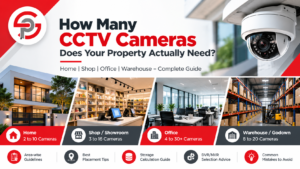
In this guide, we explain in simple words where to place CCTV cameras in apartments, villas and independent floors. You will also learn about the right height, angle, lighting and the most common mistakes. If you are still deciding how many cameras to buy, you can also read our guide on how many CCTV cameras your property needs.
2. Quick Answer: Where Should You Place CCTV Cameras?
Place cameras where people enter, leave and wait. These spots give you the best view of anyone who comes near your home. Cover the main door, the gate, the parking area, the staircase, the back entry and the ground-floor windows. Inside the home, keep cameras only in common areas such as the living room or passage. Never place them in bedrooms or bathrooms.
Here is a simple starting point:
- Apartment: 2 to 3 cameras (main door, corridor side, living area)
- Independent floor: 3 to 4 cameras (street entry, staircase, floor door, parking)
- Villa: 6 to 8 cameras or more (gate, boundary, parking, garden, back door, terrace)
Fix outdoor cameras about 9 to 10 feet above the ground and tilt them slightly down. This keeps them out of easy reach and still shows faces clearly.
3. Five Basic Rules of Good CCTV Placement
Before we go property by property, learn these five rules. They work for every home.
Rule 1: Cover every entry and exit point. Thieves use doors, gates, windows and terraces. Your CCTV cameras should watch all the ways someone can come in or go out.
Rule 2: Aim for a clear face, not just a shape. A camera that is too far or too high only records a small figure. Place the camera so that a person’s face looks big and clear when they walk toward it.
Rule 3: Avoid direct light and sun. If a camera faces a bright bulb, the sun or a glass door, the picture turns white. Choose a spot where light falls on the person, not into the lens.
Rule 4: Keep cameras safe from hands and weather. Do not fix them where anyone can touch or turn them. Use weatherproof cameras outside, because dust, rain and heat can damage them.
Rule 5: Respect privacy. Point cameras at your own property. Do not record a neighbour’s door, window or private space. Never use cameras in bedrooms, bathrooms or changing areas.
4. CCTV Placement for Apartments
Apartments are small, so you do not need many cameras. The aim is to watch who comes to your door and who moves around inside.
Main door. This is the most important spot. Place one camera that faces the door, or use a video door phone. It lets you see and talk to the visitor without opening the door. It is very useful for delivery staff, guests and strangers.
Corridor or lift lobby. If your society allows it, fix a small camera that covers the area just outside your door. Take permission from the society first, since corridors are shared spaces.
Living room. A camera here covers the main entry and the room where valuables are often kept. Place it in a corner, about 7 to 8 feet high, so it sees the whole room.
Balcony. Ground-floor and first-floor flats should cover the balcony, because it can be an easy way in. Higher floors can usually skip this.
Many people in flats live on rent and cannot drill walls. In that case, wireless Wi-Fi and 4G cameras are a good choice. They are easy to fix, easy to move and can be watched on your mobile phone.
5. CCTV Placement for Villas
A villa has more land, more doors and more blind spots. Your plan should work in layers, from the outer boundary to the inner rooms.
Gate and boundary. The gate is the first checkpoint. Place one camera on the gate pillar or wall that sees every person and vehicle entering. Add cameras along the boundary wall to cover long sides and corners.
Driveway and parking. Place a camera that covers cars, bikes and the garage door. Fix it so that it can read number plates in daylight.
Garden and side passage. Dark side lanes and gardens are favourite hiding spots for thieves. A camera with good night vision at each corner covers them well.
Back door and rear entry. Many break-ins happen from the back, where nobody is watching. Never leave this side without a camera.
Terrace and staircase. Cover the terrace door and the top of the staircase, since thieves often climb up from outside.
Inside the house. Keep cameras in the main hall, at the foot of the stairs and near the main entry.
For a villa, a wired system with many channels is a smart choice. It needs a DVR or NVR to record all cameras in one place. Trusted brands like Hikvision and CP Plus offer cameras for gates, gardens and boundaries in both HD and IP models.
6. CCTV Placement for Independent Floors
Independent floors are everywhere in Delhi and other big cities. Usually two to four families live in one building, each on a different floor. This brings its own security needs.
Street entry or main gate. Put one camera that sees everyone coming in from the road. This is the most useful camera for the whole building.
Staircase entry. Cover the staircase from the ground floor. Anyone going to the upper floors must pass here, so it works like a checkpoint.
Your floor door. Place a camera or video door phone near your own door. This shows who comes to your floor, even if the main gate was left open.
Parking or stilt area. Cars and two-wheelers are often parked here. Place a camera that covers all vehicles and the entry of the parking area.
Rear lane or terrace. If the building has a back lane or an open terrace, cover it as well.
A good idea is to set up one common system for the whole building. All floors can share the cost, and one recorder can store the video from every camera. Please avoid pointing cameras into another family’s private space. Talk to your neighbours before you start, so everyone is comfortable.
7. Indoor Camera Placement: Do’s and Don’ts
Cameras inside the house need extra care because they record your family.
Do:
- Place cameras in common spaces such as the hall, passage and entry area.
- Fix cameras in a corner so they see the whole room.
- Cover the room where cash, jewellery or a safe is kept.
- Tell your family about every indoor camera.
Don’t:
- Do not place cameras in bedrooms, bathrooms or changing rooms.
- Do not point a camera at a window with strong sunlight.
- Do not hide cameras in a way that breaks anyone’s trust.
- Do not put a camera so close to a wall that it sees only a few feet of space.
Remember, the aim is safety, not watching family members all day.
8. Best Height and Angle for Cameras
Height and angle decide whether you get a clear picture or a useless one.
- Outdoor cameras: 9 to 10 feet high. This is high enough to stay away from hands and low enough to catch faces.
- Indoor cameras: 7 to 8 feet high, in a corner.
- Door cameras: about 5 to 6 feet high, close to eye level, so they catch the face of anyone standing at the door.
For the angle, tilt the camera slightly downward, about 15 to 30 degrees. If it is tilted too much, you will only see the top of people’s heads. If it is too flat, you will see a lot of sky and ground.
Also remember that a camera sees best when people walk toward it. A person walking toward the lens shows the full face, while a person walking sideways shows only a small part. So whenever possible, place the camera so that visitors come toward it.
Lastly, check the distance. Most home cameras give a clear face only up to a limited distance, often around 15 to 20 feet. If your gate is far from the house, choose a camera with a better lens.
9. Lighting and Night Vision Tips
Most thefts happen at night, so night video quality is very important.
Use cameras with good night vision. Standard cameras use infrared and give black-and-white video in the dark. Newer cameras with colour night vision show colour even at night, which helps you see the colour of clothes and vehicles. Many modern models in the Hikvision HD and IP range offer these features.
Add a light near the camera. A simple outdoor light near the door or gate gives a much clearer night picture. Motion sensor lights also warn thieves that someone has noticed them.
Avoid glare. Do not place the camera right next to a bulb. The bulb will make a bright white spot and the face will turn dark.
Watch out for glass. Infrared light can bounce back from window glass and spoil the picture. Keep the camera a little away from glass, or place it outside the window.
Clean the lens. Dust, spider webs and water drops can blur the video. Clean the lens once a month.
10. Choosing the Right Camera Type for Each Spot
Not every camera suits every place. Here is a simple guide.
- Bullet cameras: Best for gates, boundary walls and parking. They are weatherproof and also warn people that a camera is watching.
- Dome cameras: Best for corridors, halls and ceilings. They look neat and are harder to turn away.
- Pan and tilt cameras: Best for living rooms and large halls. They can rotate to cover more area.
- Wi-Fi cameras: Best for flats and rented homes. They need no long cable and work with a mobile app.
- 4G cameras: Best for places without Wi-Fi, such as a farmhouse, a plot or a construction site. They use a SIM card.
- Video door phones: Best for the main door, so you can see and talk to visitors.
In a villa, a mix of these usually works best: bullet cameras outside, dome cameras inside and a video door phone at the entry.
11. Power, Wiring and Recording Tips
A good placement plan also needs good power and storage.
Plan the wire path early. Decide the camera spots before painting or finishing the walls, so that wires can be hidden inside pipes. Visible wires are easy to cut.
Use a proper power supply. Cameras need steady power. A good quality SMPS and PoE switch keeps your cameras running safely and avoids problems from voltage drops.
Keep the recorder safe. Place the DVR or NVR in a hidden, dry place, away from the main door. If a thief finds and takes the recorder, all your video is gone.
Choose enough storage. Video takes a lot of space. A surveillance hard disk is made to run day and night, unlike a normal computer drive. For a home, 15 to 30 days of recording is a good target.
Add backup power. A small UPS keeps cameras and the recorder working during power cuts, which is exactly when thieves like to strike.
Take expert advice. If you are not sure about your plan, talk to a trusted CCTV camera dealer in Delhi. They can listen to your needs and suggest the best spots, the number of cameras and the right brand.
12. Common Placement Mistakes to Avoid
- Placing cameras too high. Cameras on the ceiling of a tall porch show only the top of heads.
- Facing the sun or a bulb. The picture turns white and useless.
- Leaving blind spots. Check that camera views overlap a little, so no corner stays uncovered.
- Covering only the front. Thieves often go to the back and sides.
- Fixing cameras within reach. Anyone can turn, cover or break them.
- Forgetting the staircase and terrace. In flats and floors, these are common ways in.
- Ignoring privacy. Pointing a camera at a neighbour can cause legal and personal trouble.
- Not testing after installation. Always walk around, check the live view and play back the video before you finish.
13. FAQs
Q1. Where is the best place to put a CCTV camera in a flat?
The best spot is the main door. Add one more camera in the living room. A video door phone is also a smart choice for the entrance.
Q2. How high should I fix a CCTV camera?
Fix outdoor cameras 9 to 10 feet high and indoor cameras 7 to 8 feet high. Door cameras should be at about eye level, around 5 to 6 feet.
Q3. How many cameras does a villa need?
Most villas need 6 to 8 cameras. The exact number depends on the size of the plot, the boundary and the number of entry points.
Q4. Can I fix a CCTV camera in the corridor of my apartment?
Corridors are shared spaces, so take permission from your society or neighbours first. Make sure the camera only covers your own door area.
Q5. Are Wi-Fi cameras good for apartments?
Yes, they are easy to set up and work well in flats and rented homes. They need a stable internet connection. If you have no Wi-Fi, a 4G camera is a good option.
Q6. Is it okay to place cameras inside bedrooms?
No. Never place cameras in bedrooms, bathrooms or changing areas. Keep indoor cameras in common spaces only.
Q7. For how many days should I store CCTV video?
For most homes, 15 to 30 days is enough. Choose a hard disk size and video quality that match this goal.
14. Conclusion
Good CCTV placement is simple when you follow a few basic ideas. Cover every entry and exit, aim for clear faces, avoid bright light, and keep cameras out of reach. Flats need fewer but smarter cameras, independent floors need strong cover at the street entry and staircase, and villas need layered protection from the gate to the inner rooms.
Take a little time to plan before you fix anything. Walk around your home like a thief would, note the weak spots, and place cameras there. A well-placed camera system gives you real peace of mind, whether you are at home, at work or on holiday.
Padamshree Infotech is here to help you choose the right cameras, recorders and accessories for your home.